|
As I
executed the hazardous turns at a snail's pace, I was
praying to reach the turnoff at Blue Jay that would
signify I had arrived. When I finally walked into
Carolyn's house and hugged and greeted my grandchildren I
said, "Forget the daffodils, Carolyn! The road is
invisible in the clouds and fog, and there is nothing in
the world except you and these darling children that I
want to see bad enough to drive another inch!"
My daughter smiled calmly," We drive in this all the
time, Mother."
"Well,
you won't get me back on the road until it clears--and
then I'm heading for home!" I assured her.
"I was hoping you'd take me over to the garage to
pick up my car. The mechanic just called, and they've
finished repairing the engine," she answered.
"How far will we have to drive?" I asked
cautiously.
"Just a few blocks," Carolyn said cheerfully.
So we buckled up the children and went out to my car.
"I'll drive," Carolyn offered. "I'm used to
this." We got into the car, and she began driving.
In a few minutes I was aware that we were back on the
Rim-of-the-World Road heading over the top of the
mountain. "Where are we going?" I exclaimed,
distressed to be back on the mountain road in the fog.
"This isn't the way to the garage!"
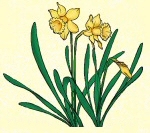 "We're
going to my garage the long way," Carolyn smiled,
"by way of the daffodils." "We're
going to my garage the long way," Carolyn smiled,
"by way of the daffodils."
"Carolyn,"
I said sternly, trying to sound as if I was still the
mother and in charge of the situation, "please turn
around. There is nothing in the world that I want to see
enough to drive on this road in this weather."
"It's all right, Mother," She replied with a
knowing grin. "I know what I'm doing. I promise, you
will never forgive yourself if you miss this
experience."
And so my sweet, darling daughter who had never given me a
minute of difficulty in her whole life was suddenly in
charge -- and she was kidnapping me! I couldn't believe
it. Like it or not, I was on the way to see some
ridiculous daffodils -- driving through the thick, gray
silence of the mist-wrapped mountaintop at what I thought
was risk to life and limb.
I muttered all the way. After about twenty minutes we
turned onto a small gravel road that branched down into an
oak-filled hollow on the side of the mountain. The Fog had
lifted a little, but the sky was lowering, gray and heavy
with clouds.
We parked in a small parking lot adjoining a little stone
church. From our vantage point at the top of the mountain
we could see beyond us, in the mist, the crests of the San
Bernardino range like the dark, humped backs of a herd of
elephants. Far below us the fog-shrouded valleys, hills,
and flatlands stretched away to the desert.
On the far side of the church I saw a pine-needle-covered
path, with towering evergreens and manzanita bushes and an
inconspicuous, lettered sign "Daffodil Garden."
We each took a
child's hand, and I followed Carolyn down the path as it
wound through the trees. The mountain sloped away from the
side of the path in irregular dips, folds, and valleys,
like a deeply creased skirt.
Live oaks, mountain laurel, shrubs, and bushes clustered
in the folds, and in the gray, drizzling air, the green
foliage looked dark and monochromatic. I shivered. Then we
turned a corner of the path, and I looked up and gasped.
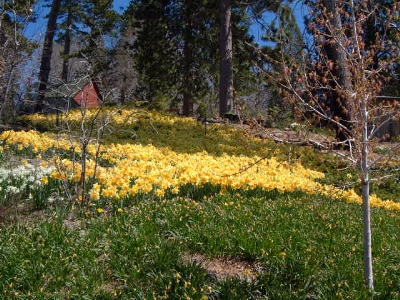
Before me lay
the most glorious sight, unexpectedly and completely splendid.
It looked as though someone had taken a great vat of gold and
poured it down over the mountain peak and slopes where it had
run into every crevice and over every rise.
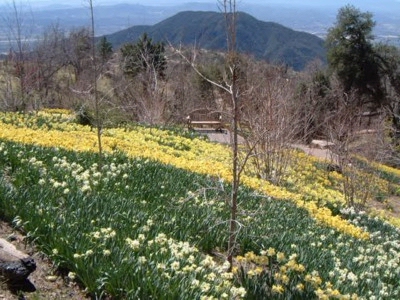
Even in the
mist-filled air, the mountainside was radiant, clothed in
massive drifts and waterfalls of daffodils. The flowers were
planted in majestic, swirling patterns, great ribbons and
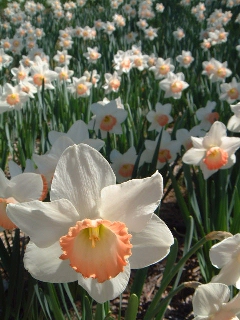
swaths of deep orange, white, lemon yellow, salmon pink,
saffron, and butter yellow.
Each different-colored variety (I learned later that there
were more than thirty-five varieties of daffodils in the vast
display) was planted as a group so that it swirled and flowed
like its own river with its own unique hue.
In the center of this incredible and dazzling display of gold,
a great cascade of purple grape hyacinth flowed down like a
waterfall of blossoms framed in its own rock-lined basin,
weaving through the brilliant daffodils. A charming path wound
throughout the garden. There were several resting stations,
paved with stone and furnished with Victorian wooden benches
and great tubs of coral and carmine tulips.
As though
this were not magnificence enough, Mother Nature had to add
her own grace note -- above the daffodils, a bevy of western
bluebirds flitted and darted, flashing their brilliance. These
charming little birds are the color of sapphires with breasts
of magenta red. As they dance in the air, their colors are
truly like jewels above the blowing, glowing daffodils. The
effect was spectacular.
It did not matter that the sun was not shining. The brilliance
of the daffodils was like the glow of the brightest sunlit
day. Words, wonderful as they are, simply cannot describe the
incredible beauty of that flower-bedecked mountain top.
Five acres of flowers! (This too I discovered later when some
of my questions were answered.) "But who has done
this?" I asked Carolyn. I was overflowing with gratitude
that she brought me -- even against my will. This was a
once-in-a-lifetime experience.
"Who?" I asked again, almost speechless with wonder,
"And how, and why, and when?"
"It's just one woman," Carolyn answered. "She
lives on the property. That's her home." Carolyn pointed
to a well-kept A-frame house that looked small and modest in
the midst of all that glory.
We walked up to the
house, my mind buzzing with questions. On the patio we saw a
poster.
|
"Answers
to the Questions
I Know You Are Asking"
50,000
bulbs
One at a time,
by one woman,
two hands,
two feet,
and very little brain
Began in 1958 |
There it
was. The Daffodil Principle.
For me that
moment was a life-changing experience. I thought of this woman
whom I had never met, who, more than thirty-five years before,
had begun -- one bulb at a time -- to bring her vision of
beauty and joy to an obscure mountain top. One bulb at a time.
There was no other way to do it. One bulb at a time. No
shortcuts -- simply loving the slow process of planting.
Loving the work as it unfolded.
Loving an achievement that grew so slowly and that bloomed for
only three weeks of each year. Still, just planting one bulb
at a time, year after year, had changed the world.
 This
unknown woman had forever changed the world in which she
lived. She had created something of ineffable magnificence,
beauty, and inspiration. This
unknown woman had forever changed the world in which she
lived. She had created something of ineffable magnificence,
beauty, and inspiration.
The principle her daffodil garden taught is one of the
greatest principle of celebration:
-
learning
to move toward our goals and desires one step at a time
(often just one baby-step at a time),
-
learning
to love the doing,
-
learning
to use the accumulation of time.
When we
multiply tiny pieces of time with small increments of daily
effort, we too will find we can accomplish magnificent things.
We can change the world.
"Carolyn," I
said that morning on the top of the mountain as we left the
haven of daffodils, our minds and hearts still bathed and
bemused by the splendors we had seen, "it's as though
that remarkable woman has needle-pointed the earth! Decorated
it. Just think of it, she planted every single bulb for more
than thirty years. One bulb at a time! And that's the only way
this garden could be created. Every individual bulb had to be
planted. There was no way of short-circuiting that process.
Five acres of blooms. That magnificent cascade of hyacinth!
All, all, just one bulb at a time."
The thought of it filled my mind. I was suddenly overwhelmed
with the implications of what I had seen. "It makes me
sad in a way," I admitted to Carolyn. "What might I
have accomplished if I had thought of a wonderful goal
thirty-five years ago and had worked away at it 'one bulb at a
time' through all those years. Just think what I might have
been able to achieve!"
My wise daughter put the car into gear and summed up the
message of the day in her direct way. "Start
tomorrow," she said with the same knowing smile she had
worn for most of the morning. Oh, profound wisdom!
It is pointless to think of the lost hours of yesterdays. The
way to make learning a lesson a celebration instead of a cause
for regret is to only ask...
"How
can I put this to use tomorrow?"

Source:
"The Secret Garden"
(also known as, The Daffodil
Principle and Where the Sun Splashed Gold, from Things I
Wish I'd Known Sooner,Reader's
Digest, Canadian edition)
by Jaroldeen
Asplund Edwards |